
Feeling Less Confident Than You Used To? The Confidence Shift Many Men Don’t Talk About
Many men don’t talk openly about how deeply appearance changes affect their confidence — not because it doesn’t matter, but because they’ve learned they’re supposed to handle it privately.
Maybe your hairline has changed.
Maybe your body doesn’t feel as familiar or responsive as it once did.
Maybe you feel disconnected from your style, unsure how to dress yourself anymore, or hyper-aware of how you’re perceived in social or dating spaces.
These experiences don’t usually arrive all at once. They accumulate quietly. And over time, they can begin to shape how you show up — or don’t — in your relationships, work, and inner life.
This isn’t about vanity. It’s about identity, nervous system safety, and self-worth.

When Appearance Shifts Trigger an Identity Shift
For many men, appearance is woven into identity in subtle but powerful ways. Hair, posture, clothing, and physical presence all influence how a man experiences himself in the world.
When something changes — thinning hair, aging, weight changes, or a loss of confidence in how you present yourself — it can feel destabilizing. Not because you “need” to look a certain way, but because the version of you that once felt comfortable being seen no longer feels accessible.
Psychologically, this can activate:
- A sense of loss or grief
- Heightened self-monitoring
- Anxiety around being perceived or judged
- Withdrawal from intimacy or social exposure
These reactions are not irrational. They’re protective.

Hair Loss and Masculine Self-Worth
Hair loss is one of the most common appearance-related stressors for men, yet one of the least emotionally validated.
Culturally, hair is often associated with:
- Youth and vitality
- Sexual desirability
- Confidence and presence
- Masculine identity
When hair begins to thin or recede, many men report:
- Increased self-consciousness in public or under bright lighting
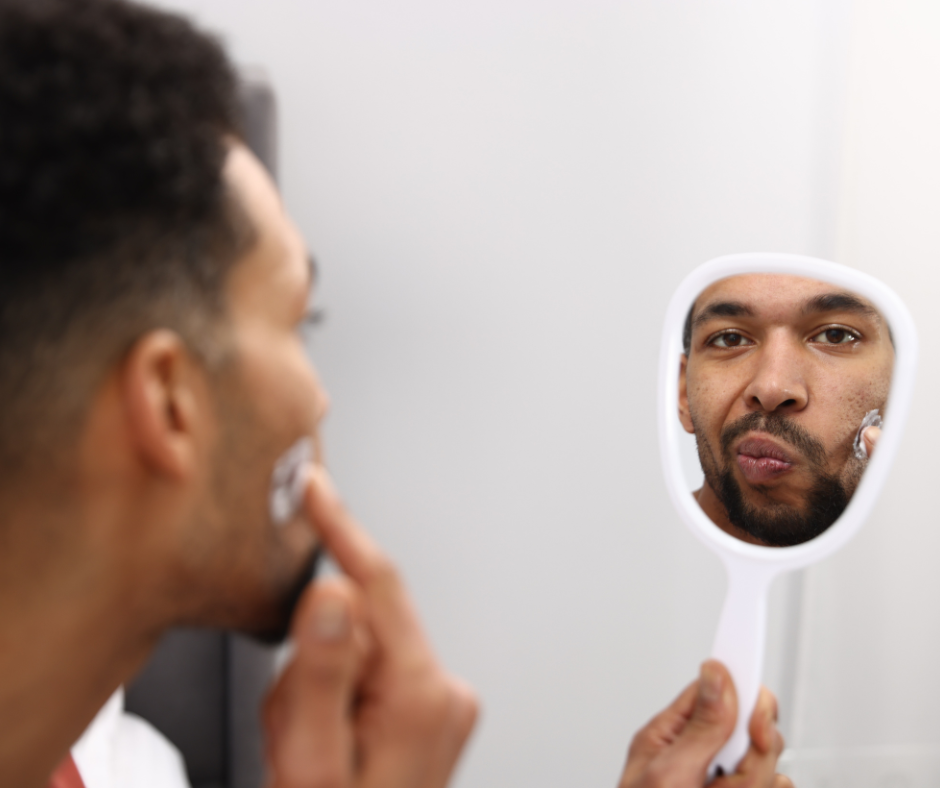
- Avoidance of mirrors, photos, or dating apps
- Anxiety during intimacy or vulnerability
- A feeling of losing control over their body
Minimizing this experience doesn’t make it easier. It often deepens shame and isolation.
How Insecurity Changes Behavior Before You Notice
Loss of confidence doesn’t usually announce itself clearly. It shows up behaviorally.
You may notice:
- Pulling back from dating or social events
- Choosing clothing meant to hide rather than express
- Avoiding eye contact or photos
- Feeling tense or guarded in conversations
- Needing reassurance but struggling to ask for it
Over time, these patterns can shrink your world — not because you aren’t capable, but because your nervous system is prioritizing protection over expansion.

The Nervous System and Appearance-Based Insecurity
From a nervous system perspective, insecurity is not a character flaw. It’s a threat response.
When your brain perceives risk — judgment, rejection, humiliation — it activates protective strategies:
- Hypervigilance
- Withdrawal
- Self-criticism
- Overcontrol
If appearance feels like the source of threat, the body learns to stay alert in situations where you’re seen. This is why confidence struggles often feel physical — tightness, fatigue, restlessness — not just mental.
Therapist-Approved Ways to Rebuild Confidence With Depth and Care
1. Acknowledge the Loss Without Self-Judgment
Confidence struggles often begin with unrecognized grief. When something about your body, appearance, or sense of self changes, your nervous system notices — even if you tell yourself it “shouldn’t matter.” Naming the loss allows your system to process rather than suppress it, which reduces shame over time.
- Reflect on what genuinely feels different now versus before, without rushing to fix it
- Allow sadness, frustration, or anger to exist without minimizing or rationalizing it away
- Separate loss from self-blame — change is not a personal failure
Grief that is acknowledged tends to soften; grief that is ignored often turns inward.

2. Understand the Story Your Brain Is Telling
Insecurity is often sustained by internal narratives rather than objective reality. The brain fills in gaps when it feels uncertain, especially around social acceptance or attractiveness. These stories can feel convincing even when they aren’t accurate.
- Notice thoughts about how others “must” be perceiving you
- Ask whether these thoughts are assumptions, interpretations, or verified facts
- Practice replacing certainty (“They’re judging me”) with curiosity (“I don’t actually know”)
Confidence grows when your perception becomes flexible instead of rigid.
3. Reclaim Agency Where You Still Have Choice
Loss of control intensifies insecurity. When parts of your appearance feel outside your control, your nervous system can interpret that as a broader loss of agency. Regaining choice — even in small ways — helps restore internal stability.
- Experiment with grooming, styling, or self-presentation that feels intentional rather than corrective
- Choose clothing that supports comfort, movement, and presence — not concealment
- Focus on how you want to feel in your body, not just how you want to look
Agency restores a sense of authorship over your identity.

4. Regulate the Nervous System First
Confidence doesn’t emerge from willpower alone; it follows regulation. When your body feels tense or vigilant, your mind becomes self-monitoring and critical. Supporting your nervous system creates the conditions for confidence to reappear naturally.
- Practice slow, grounding breathing before social or public situations
- Use physical grounding through posture, stretching, or steady movement
- Reduce caffeine or stimulants that increase internal scanning and anxiety
A calmer body makes self-assurance more accessible.
5. Address Avoidance Gently, Not Aggressively
Avoidance protects you in the short term but reinforces insecurity over time. The goal isn’t to push yourself into overwhelming situations, but to rebuild trust through tolerable exposure.
- Identify where you’ve been pulling back — dating, social events, visibility
- Choose small, manageable steps rather than dramatic challenges
- Reflect afterward on what actually happened versus what you feared would happen
Safety grows through experience that feels survivable, not forced.

6. Expand Masculinity Beyond Appearance
Rigid definitions of masculinity increase pressure and shame. When worth is tied to looks, control, or invulnerability, confidence becomes fragile. Broadening masculinity allows identity reminds your nervous system that you are more than a single dimension.
- Explore qualities you genuinely respect in other men beyond appearance
- Notice strength expressed through steadiness, integrity, humor, or care
- Gently challenge cultural messages that equate worth with youth or aesthetics
Identity becomes safer when it’s multidimensional.
7. Rebuild Self-Trust Through Consistency
Confidence grows less from external validation and more from internal reliability. When you learn that you can count on yourself — even imperfectly — self-esteem begins to stabilize.
- Keep small commitments rather than setting unrealistic expectations
- Follow through on self-care without needing it to be perfect
- Notice moments where your actions align with your values
Self-trust often comes before confidence, not after.

8. Reduce Comparison Exposure
Comparison activates threat responses quickly and unconsciously. Your nervous system wasn’t designed to constantly evaluate itself against curated, idealized images. Reducing exposure protects your internal baseline.
- Limit social media or content that centers idealized appearance standards
- Notice when comparison spikes tension, self-criticism, or withdrawal
- Re-anchor in your own values, pace, and lived reality
Confidence weakens in comparison and strengthens in self-reference.
9. Practice Being Seen Without Performing
Many men equate being seen with being evaluated. Over time, this creates pressure to perform rather than simply exist. Learning to be visible without impressing can feel uncomfortable — and deeply freeing.
- Allow yourself to show up without trying to manage how you’re perceived
- Notice discomfort without immediately escaping or compensating
- Practice neutral presence — neither hiding nor proving
You don’t need to earn the right to take up space.

10. Explore Identity Beyond Performance
Achievement and appearance often become stand-ins for identity when self-connection is underdeveloped. Reconnecting with who you are beyond output helps confidence feel more grounded and less conditional.
- Ask what feels meaningful outside productivity or success
- Revisit curiosity, interests, or creativity without goals attached
- Notice who you are when no one expects anything from you
A stable sense of self supports lasting confidence.
11. Allow Support Without Interpreting It as Weakness
Isolation magnifies insecurity. Many men are taught to handle things independently, but nervous systems regulate best through connection. Letting others in doesn’t reduce strength — it expands resilience.
- Share selectively with people who feel safe and respectful
- Normalize vulnerability as a human experience, not a flaw
- Allow relational support to help settle your system
Connection is a biological need, not a personal failing.
12. Work With a Therapist on Identity and Self-Worth
Professional support can help untangle the layers between appearance, shame, identity, and nervous system responses. Therapy isn’t about changing who you are — it’s about reconnecting with yourself more fully.
- Trauma-informed therapy to address underlying nervous system patterns
- Identity-focused work to rebuild self-concept beyond appearance
- Somatic or attachment-based approaches to restore internal safety
Therapy isn’t about fixing — it’s about coming home to yourself.
Therapy isn’t about fixing — it’s about reconnecting.
When Confidence Shifts Quietly (And No One Teaches You How to Talk About It)
For many men, changes in confidence don’t happen overnight. There’s no single moment where everything falls apart. Instead, it’s gradual — a subtle shift in how you carry yourself, how you enter rooms, how long you hesitate before speaking up or putting yourself out there. You might notice yourself checking mirrors more often, avoiding certain lighting, or replaying interactions in your head wondering how you came across.
Because men are often socialized to equate confidence with strength, control, or competence, these internal changes can feel deeply unsettling. You may still be functioning well on the outside — working, socializing, showing up — while internally feeling disconnected from the version of yourself you used to recognize. This dissonance can create quiet shame, especially when you don’t have language for what’s happening or spaces where it feels acceptable to say, “I don’t feel like myself anymore.”

Appearance Changes and the Nervous System: It’s Not “Just In Your Head”
When aspects of your appearance shift — hair thinning, changes in body composition, aging skin, or even how clothes fit — your brain doesn’t interpret this neutrally. The nervous system is wired to monitor cues related to safety, belonging, and social acceptance. For many men, appearance becomes unconsciously tied to these cues, even if you logically reject that idea.
If your nervous system perceives a change as a potential threat to belonging or desirability, it may respond with heightened self-monitoring, anxiety, or withdrawal. This can look like:
- Feeling tense in social settings
- Overanalyzing how others perceive you
- Avoiding dating, photos, or certain environments
These reactions aren’t vanity or weakness. They’re adaptive responses from a brain trying to protect you from perceived rejection or loss of status. Understanding this can shift the narrative from “What’s wrong with me?” to “What is my system responding to right now?”
Masculinity, Silence, and the Pressure to “Handle It”
Many men grow up learning that discomfort around appearance or self-worth is something to deal with privately — or not at all. Talking about insecurity can feel risky, emasculating, or unnecessary, especially if you’ve been taught that confidence should be automatic or earned through achievement alone.
As a result, many men internalize their struggles rather than expressing them. Instead of naming insecurity, it may show up as irritability, emotional distance, perfectionism, or disengagement from intimacy. You might find yourself minimizing your own experience — telling yourself it’s shallow to care, or that others have it worse — while the impact quietly accumulates.
This silence doesn’t mean you’re coping well. It often means you’re coping alone. And isolation, even subtle isolation, can amplify insecurity over time.

How Confidence Loss Affects Dating, Intimacy, and Connection
When confidence feels shaky, putting yourself out there can feel exhausting or risky. You might hesitate to date, delay initiating conversations, or assume rejection before it happens. In relationships, insecurity can make it harder to feel relaxed, present, or open — even with someone who genuinely cares about you.
You may notice:
- Pulling back emotionally to avoid being seen too closely
- Seeking reassurance but feeling uncomfortable asking for it
- Interpreting neutral behavior as disinterest or judgment
Over time, this can create distance — not because you don’t want connection, but because your nervous system is trying to protect you from perceived vulnerability. Without awareness, this pattern can reinforce the belief that confidence loss means you’re less desirable or less worthy of connection, when in reality it means you’re human and navigating change.
Rebuilding Confidence Is Not About “Fixing” Yourself
One of the biggest misconceptions about confidence is that it’s something you regain by changing how you look, dressing better, or achieving more. While external adjustments can be supportive, confidence at its core is an internal sense of safety and self-trust.
Lasting confidence comes from:
- Feeling grounded in your body
- Trusting your worth even when things feel uncertain
- Learning how to stay connected to yourself during change
This doesn’t mean ignoring appearance-related feelings or pretending they don’t matter. It means understanding them within a broader psychological and emotional context — one where self-worth isn’t fragile or conditional.
Therapy often helps men rebuild confidence not by eliminating insecurity, but by helping them relate to it differently — with less judgment, more curiosity, and greater emotional flexibility.
You’re Not Losing Yourself — You’re Being Asked to Rebuild
At KMA Therapy, we support men navigating self-esteem, identity transitions, appearance-related insecurity, and confidence challenges with depth and respect. Our trauma-informed therapists understand how nervous system responses, cultural expectations, and unspoken shame shape self-worth.
We help clients reconnect with themselves beyond comparison, performance, or appearance — building confidence that feels steady, embodied, and sustainable.
💬 Book a free 15-minute discovery call to begin rebuilding confidence in a way that honors who you are now — not who you think you’re supposed to be.


